


Various industries require high-quality water through advanced treatment methods. One of the modern technologies in this field is Nanofiltration (NF). This process uses semi-permeable membranes under moderate operating pressure to remove multivalent ions, organic compounds, color, and water hardness, while allowing some monovalent ions such as sodium and chloride to pass through. This feature positions NF between Ultrafiltration (UF) and Reverse Osmosis (RO).
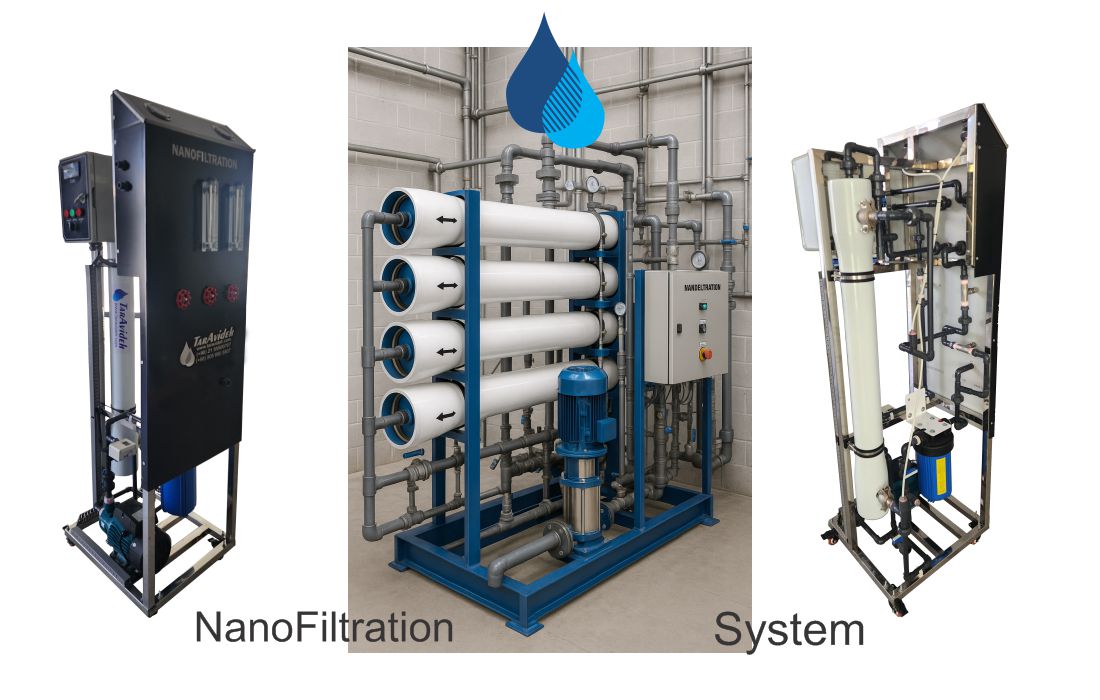
What is Nanofiltration?
Nanofiltration is a pressure-driven membrane process that removes particles as small as 0.001 microns.
-
Removal range: 200–1000 Dalton
-
Operating pressure: 4–30 bar (lower than RO)
-
Recovery rate: 40–60% depending on feedwater quality
NF Membrane Mechanism
1. Membrane Structure
NF membranes are semi-permeable and can:
-
Remove large molecules and multivalent ions
-
Allow partial passage of monovalent ions like sodium and chloride.
Main layers:
-
Active layer: Responsible for selective separation, usually made of composite polyamides.
-
Support layer: Provides mechanical strength to the membrane.
2. NF Membrane Types
-
NF90 / NF270: Commonly used for hardness and organic removal in food and drinking water applications.
-
Low-Pressure NF: Operates at lower pressure, suitable for wastewater reuse and energy savings.
-
High-Rejection NF: Removes more ions and organics, approaching RO performance.
3. Key Features
-
Removal range: 50–99% for multivalent ions
-
TDS range: Suitable for medium TDS water (typically 200–1000 ppm)
-
Operating pressure: 4–30 bar
-
Temperature: Up to 45–50°C
Advantages of NF Membranes
-
Selective hardness removal: Prevents scaling and improves product quality
-
Reduces color and dissolved organics
-
Lower operating pressure than RO → energy savings
-
Lower maintenance and replacement cost compared to RO
Challenges and Maintenance
-
Scaling: Requires antiscalants and pH control to prevent scaling.
-
Biofouling: Requires periodic cleaning and biocide treatment.
-
Sensitivity to chlorine/oxidants: Free chlorine must be removed before NF.
-
Excessive pressure or hydraulic shock: Can damage membranes.
Mechanism of Action:
-
Surface and depth filtration: Large molecules, bacteria, and organics cannot pass.
-
Selective ion rejection: Multivalent ions (Ca²⁺, Mg²⁺, SO₄²⁻, NO₃⁻) are mostly removed.
-
Retention of monovalent ions: Some Na⁺ and Cl⁻ pass to maintain TDS balance.
Industrial Applications of NF
-
Municipal drinking water: Removes hardness, color, and organics.
-
Food & beverage industry: Improves water quality for production lines, clarifies juices, concentrates milk.
-
Pharmaceutical and healthcare industries: Removes microorganisms and dissolved organics.
-
Wastewater treatment & reuse: Reduces COD and color in industrial effluent.
-
Boilers & cooling towers: Controls scaling and water hardness.
-
RO pretreatment: Reduces salt load and extends RO membrane life.
Advantages of NF vs. Other Methods
-
Lower operating pressure than RO → energy savings
-
Selective removal of multivalent ions → reduces hardness and scaling
-
Partial passage of monovalent salts → preserves natural taste of drinking water
-
Lower capital and operational costs than RO
-
Can be combined with UF, RO, or MBR for hybrid systems
Limitations & Potential Issues
-
Passage of some monovalent ions: For very high TDS, NF efficiency is limited and RO may be required.
-
Scaling: Ca²⁺, SO₄²⁻, and other ions can precipitate on the membrane → antiscalants required.
-
Biofouling: Microbial growth on the membrane reduces water flux.
-
Membrane sensitivity to chlorine/oxidants: Direct contact damages NF membranes.
-
Need for proper pretreatment: Sand, carbon, and cartridge filters are essential to prevent membrane clogging.
Performance Improvement Strategies
-
Use acidic and alkaline antiscalants for scale control.
-
Periodic chemical cleaning (CIP) based on type of fouling.
-
Biological control with controlled biocide dosing.
-
Monitor feedwater quality (SDI < 5).
-
Select NF membranes according to feedwater quality and industrial application.
NF vs. RO Comparison
| Feature | RO | NF | Remarks |
|---|---|---|---|
| Operating Pressure | 15–70 bar | 4–30 bar | NF lower pressure |
| Salt Rejection | Nearly complete | Selective (multivalent) | NF partial monovalent passage |
| Energy Consumption | Higher | Lower | |
| Applications | Full desalination | Hardness reduction, organics removal, RO pretreatment | |
| Cost | Higher | Lower |
Examples of NF Applications
Textile & Dyeing Industry:
-
Color removal from effluent: Retains color molecules and large organics, clarifies water, allows reuse.
-
Hardness reduction: Removes Ca²⁺ and Mg²⁺ → more uniform dyeing.
-
Chemical savings: Softer water reduces need for dye fixatives.
-
Water recycling: Reuses part of the process water → economic savings + environmental protection.
Food & Beverage Industry:
-
Improves taste, color, and quality of products.
-
NF removes multivalent ions and large organics → clearer, lighter water → higher-quality beverages.
Key point: NF enhances clarity and taste while reducing chemical usage.
Summary
Nanofiltration (NF) is an advanced industrial water treatment method ideal for removing hardness, organics, color, and biological contaminants. NF is more cost-effective than RO when partial TDS reduction and selective ion removal are sufficient. With proper design, pretreatment, and use of chemical aids such as antiscalants, NF systems can achieve maximum performance and extend membrane life.